
When I started looking at how brands that manufacture in China sell to customers in the US and Europe, I made a list of the overseas warehouses they use and searched for the WooCommerce integration of each one. JD Logistics: a Shopify app. WINIT: a Shopify app. 4PX: a Shopify app. Goodcang: you can guess.
WooCommerce runs a very large share of the online shops out there, and yet, for this particular model, it was the uninvited guest. So let me explain the model first, and then why I think it deserves better than a CSV export every morning.
How the overseas warehouse model works
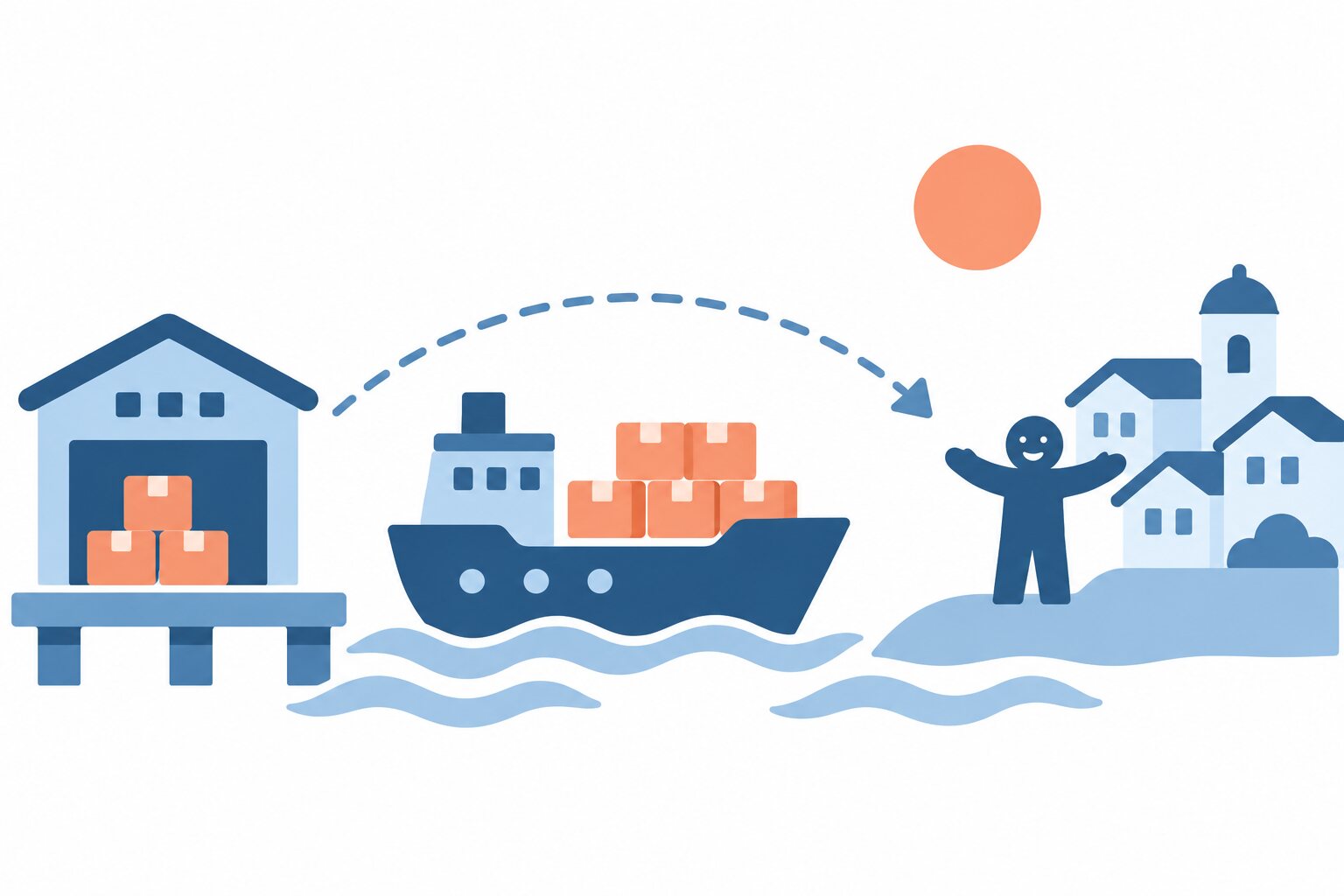
The idea is simple (the logistics behind it, not so much). Instead of shipping every single order from a factory in Shenzhen to a customer in Ohio or Lyon, the brand sends its stock in bulk, by sea or by air, to a warehouse that is already in the destination market. That is the “overseas warehouse”. From then on, every order is a domestic shipment.
The flow, once everything is in place, goes like this:
- The stock sits in the overseas warehouse, under your SKUs, in your account with the operator.
- A customer buys on your WooCommerce shop. The order is created in your store, as always.
- The order goes out from the shop to the warehouse, with the items and the shipping address.
- The warehouse picks, packs and hands the parcel to a last-mile carrier in the destination country.
- The tracking number comes back to the shop, so the order is marked as shipped and the customer gets the link.
In plain words: the customer sees a parcel arriving in three or four days from a local carrier, and has no idea the product left a factory on the other side of the planet two months earlier.
Why it was all Shopify
I don’t think there is a conspiracy here. Shopify is one platform, with one API, one app store and one review process. If you are a logistics company and you want to offer an integration, you build one app and you reach every Shopify merchant at once.
WooCommerce is a different animal. Every shop is its own server, with its own PHP version, its own hosting, its own collection of forty plugins that may or may not get along. There is no single place to “install the app” from the operator’s side. So the operators did the reasonable thing for them: they supported the platform that was cheap to support, and left WooCommerce merchants with spreadsheets, generic middleware or a developer on call.
And when a WooCommerce integration does exist, it is very often of the “give us your REST API key and we will fetch the orders” variety. I have written about that before, so I won’t repeat the whole rant here…
What to demand from the integration
If you are selling from an overseas warehouse with WooCommerce, or planning to, these are the things I would not negotiate.
SKUs that match, and that stay matched
The warehouse knows your products by the SKU you registered with them. Your shop knows them by whatever you typed in the product editor. If those two don’t match exactly (a trailing space is enough), the order either fails or, worse, ships the wrong thing. A decent integration maps WooCommerce products and variations to the operator’s SKUs explicitly, and tells you loudly when one is missing, before the customer finds out.
Lots and expiry dates
If you sell cosmetics, supplements, food or anything with a shelf life, the warehouse is managing batches whether you like it or not. You want that information to reach your side: which lot is available, when it expires, how much is left of each. Otherwise you discover the problem when a customer receives a cream that expired last spring.
Tracking that comes back on its own
The order leaving the shop is only half the job. The tracking number and the carrier have to come back, land in the order, appear in the customer’s email and in My Account. If someone in your team has to copy tracking numbers from the operator’s portal by hand, you don’t have an integration. You have a chore with an API.
No keys to your shop
This is the one I care about most. The warehouse needs to know what to ship and where. It does not need a WooCommerce API key that can read every order you have ever taken, and it certainly does not need an admin account. The connection should go from your shop to the warehouse, using your own account with the operator, and carry only the order being shipped.
Where Wareferry fits
Wareferry is a family of WooCommerce plugins, one per operator, built exactly around that list. There are plugins in the works for JD Logistics, WINIT and 4PX, among others. The model is push: your shop sends the order to the warehouse, using your own account with them, and the operator never receives your WooCommerce keys or any admin access. The details are in how it works.
The free version does the job for real, with no limits and no trialware. Pro adds the things that matter once volume grows: automatic sending, hourly stock sync, lots and expiry, several warehouses per country and routing rules between them. The comparison is in Free vs Pro. It works with HPOS and with the cart and checkout blocks, and the request log is masked, so personal data doesn’t end up sitting in plain text in your database.
One thing, though: it is still in development. Nothing is for sale, there are no prices, and I’m not going to tell you it has been proven in a hundred production shops, because it hasn’t. Yet.
If your stock is already sitting in a warehouse across the ocean and your WooCommerce shop is the only piece that doesn’t talk to it, join the waitlist. I’ll let you know when the first plugins are ready to install.